Scientists at MISIS University have investigated how bone implants made from biodegradable composite materials behave after implantation. To do so, they studied the properties of 3D-printed polylactide-based materials containing different fillers under conditions designed to mimic the human body.
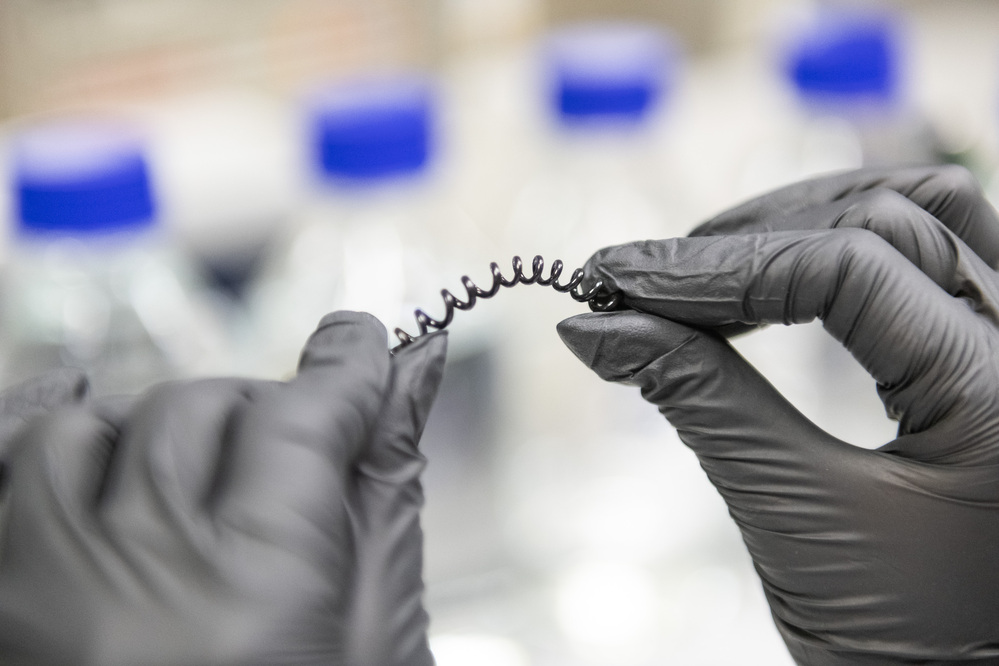
Until now, the effects of degradation inside the human body on the properties of polymer implants — including their strength, structure, and ability to interact with bone tissue cells — have not been fully understood.
“When developing biodegradable implants, it is important to understand exactly how the material’s properties will change over time. We compared two types of fillers for polylactide and found that hydroxyapatite provides the best balance of mechanical stability and biological activity, while silicon dioxide, by contrast, causes the material to become more brittle and lose strength more rapidly. These findings will help developers make informed choices about the material composition depending on the required properties of the final implant,” Anna Cheremnykh, PhD in Physics and Mathematics, Research Scientist at the Tissue Engineering and Regenerative Medicine Research and Education Laboratory at NUST MISIS.
Among the materials studied, hydroxyapatite-based composites proved to be the most promising, particularly those containing
“Cells adhered more actively to the surfaces of samples that had already undergone biodegradation than to freshly printed ones — especially when the material contained hydroxyapatite, the same mineral that makes up bone tissue. This suggests that as the material degrades, the implant surface becomes more favorable for the attachment of cells involved in bone regeneration,” Fedor Senatov, DSc in Physics and Mathematics, Director of College of Biomedical Engineering at NUST MISIS.
According to Altevina Chernikova, Rector of NUST MISIS, the university is implementing the strategic technology project Biomedical Engineering and Biomaterials as part of the national Priority 2030"program. The project focuses on developing and commercializing new products and technologies and training engineers for a rapidly growing industry. University scientists are developing solutions designed to improve the quality of life for millions of people and make treatment faster and more effective in complex medical cases.
The research was supported by the Russian Science Foundation (Grant No.