In this article, we explain why developing “smart” materials is one of the most exciting engineering careers of the future, where these specialists are in demand, and how to get started with your education.
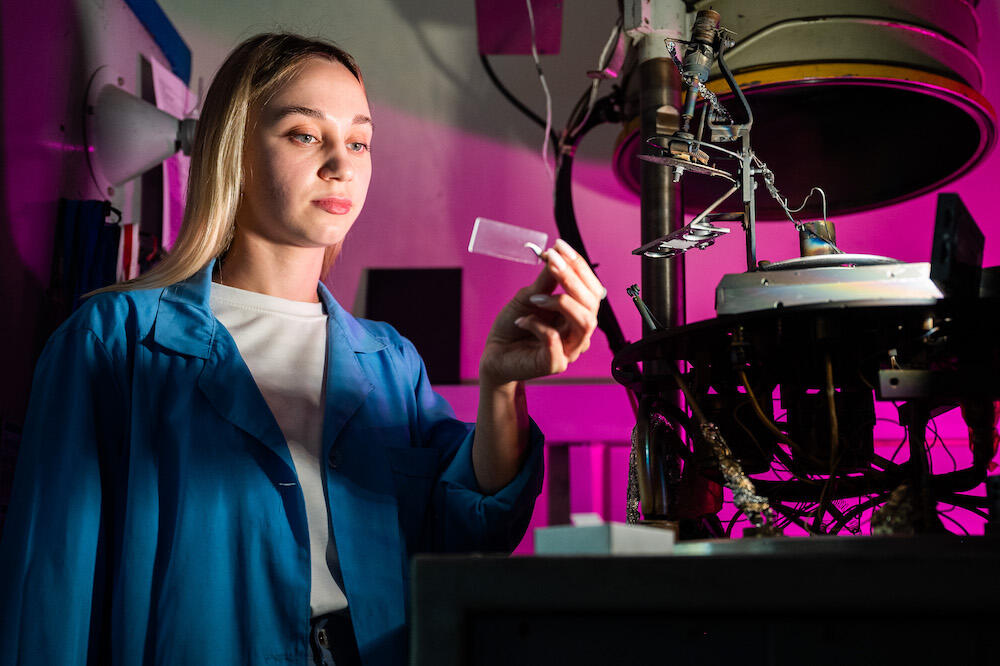
What does a smart materials developer do?
A smart materials developer (also known as a smart materials designer) is a career for people who want not only to study materials and their properties but also to create materials tailored to specific applications. New materials are needed in biomedicine, electronics, energy, transportation, aerospace, and high-tech instrumentation. These can include biomedical materials for diagnostics and drug delivery, materials for sensors, and composites and alloys for construction in extreme environments. It is important to understand how a material’s properties change at every stage of its life cycle, from development and use to recycling. That is why the profession calls for more than standardized solutions: specialists need to be able to research, compare, model, and select the best option from several possible solutions.
What challenges does a smart materials developer solve?
A materials designer develops the composition and structure of a material so that it performs a specific task: being stronger, more environmentally friendly, cheaper to produce and use, safer for people, or better at conducting heat and electricity. They synthesize materials, test them under different conditions, compare their properties, and identify the optimal solution. This is what distinguishes the profession from that of a traditional materials scientist, who more often focuses on studying the properties and behavior of materials. A developer takes the next step by creating a new solution with predetermined characteristics. Compared with a process engineer, a smart materials developer takes a broader research-based approach: they not only launch production but also design the material itself and determine the best technology for manufacturing it.
Who is a career in smart materials development right for?
This career is a good fit for ambitious young people who want to develop advanced materials and study how they perform in real-world conditions. A strong interest in physics, chemistry, mathematics, and engineering is especially valuable, along with a willingness to work carefully, thoughtfully, and analytically. By choosing this career, you can study not just theory, but how to create technologies that can be applied in industry and science.
What skills does a smart materials developer need?
This is a multidisciplinary profession requiring a broad range of knowledge. Specialists need a strong understanding of physics, chemistry, mathematics, and other fields depending on their area of specialization. They must be able to analyze data, interpret experimental results, draw conclusions based on research, and build models using IT tools. Systems thinking, attention to detail, scientific curiosity, and the ability to work with technical documentation and laboratory methods are key qualities. It is also important to see not just an individual experiment but the entire process, from an initial idea to incorporating a material into a real product or technology.
Where do smart materials developers work?
These specialists are in demand at leading high-tech companies, research centers and organizations, as well as in medtech, microelectronics, the chemical and metallurgical industries, aerospace, and the nuclear sector. They are particularly valuable wherever existing materials need to be improved or new solutions developed for systems operating under high loads.
Why is a career in smart materials development promising?
Industry is increasingly moving away from one-size-fits-all materials toward solutions tailored to specific applications: lighter, stronger, safer, more precise, and more durable. As a result, demand is growing for specialists who can apply and improve existing technologies, develop new materials, and bring them into production.
How much do smart materials developers earn?
At the entry level, salaries are generally comparable to those of junior design engineers and research engineers, ranging from RUB 100,000 to 130,000 per month. Experienced specialists typically earn RUB 130,000 to 200,000. Lead engineers and specialists with a strong portfolio and development experience can earn RUB 200,000 or more. At large companies and in management positions, the upper end of the salary range is higher.
Which program at NUST MISIS can prepare you for a career in smart materials development?
At NUST MISIS, you can prepare for this career through one of the tracks within the Materials Science and Materials Technology program, such as Innovative Materials for Nanoelectronics or Innovative Structural Materials. Students learn to develop manufacturing technologies for new materials and bring them into production while conducting research using state-of-the-art equipment. Admission requires Unified State Exam (EGE) results in mathematics, Russian language, and one additional subject of the applicant’s choice: physics, chemistry, or computer science.
You can also pursue a career in smart materials development through the Advanced Composite Materials track within the Chemical Engineering program. In this case, the required EGE subjects are chemistry and Russian language, with mathematics, computer science, and physics available as elective subjects.