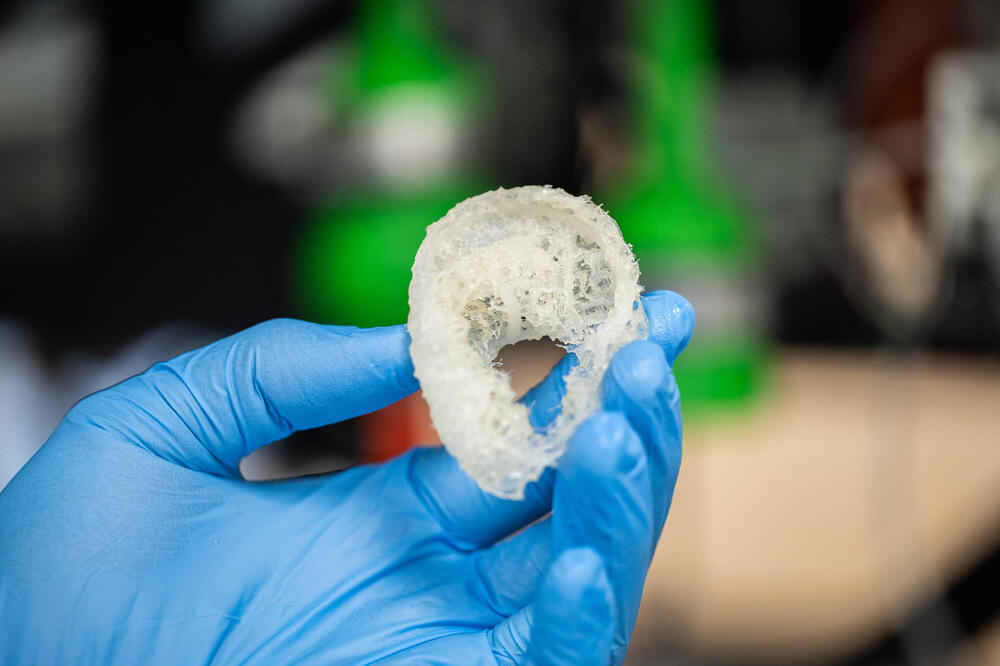
Russian scientists have for the first time recreated the natural biomechanics of the ear in an implant produced using a 3D bioprinter. The bioprosthesis not only replicates the external shape of the auditory organ but also mimics natural tissues through its composition. The researchers successfully combined a polymer framework with a soft hydrogel containing living cells — something that had previously been impossible due to the limitations of 3D bioprinting. In vivo tests confirmed that the implant develops a vascular network and successfully integrates into the body.
Microtia, a congenital abnormality of the external ear, occurs in approximately one in 10,000 newborns on average. However, current methods of reconstructing this organ still have several limitations. Autologous cartilage transplantation, in which material for the implant is taken from the patient’s own body, is associated with surgical risks such as bleeding and tissue damage, while synthetic implants made of porous polyethylene are often rejected by the body and can become a source of infection.
Biopolymer constructs printed using a 3D bioprinter avoid these drawbacks, but after implantation they often become deformed under the pressure of contracting skin. To improve implant integration after surgery, specialists from NUST MISIS, together with colleagues from the National Clinical Research Center of the Federal Medical and Biological Agency, the Dmitry Rogachev National Medical Research Center of Pediatric Hematology, Oncology and Immunology, the E. I. Chazov National Medical Research Center of Cardiology, the N. N. Priorov National Medical Research Center of Traumatology and Orthopedics, the Institute of Plastic Surgery and Cosmetology, the biotechnology company Imtek, and 3D Bioprinting Solutions developed a hybrid 3D printing method.
“We combined two different groups of materials in a single hybrid 3D bioprinting process: a porous and elastic polymer framework that provided the required biomechanics, and a soft collagen material with chondrocytes that enabled vascular network formation and rapid integration of the implant into the body. We tested two versions of the bioprosthesis framework — one with polylactide ribs and one without them. The conventional implant collapsed under load and lost half of its shape. The ribs increased the structure’s resistance to deformation by 44%,” Fedor Senatov, Doctor of Physical and Mathematical Sciences, Director of College of Biomedical Engineering at NUST MISIS.
The researchers filled the pores of the framework with a collagen hydrogel containing living chondrocytes — cells that eventually form the body’s own cartilage tissue, which is not rejected by the immune system as a foreign material. The collagen hydrogel also supports active vascular network development, which is essential because implants without blood vessels remain vulnerable to infections due to the lack of immune cell access.
Details of the study are available in the journal International Journal of Bioprinting (Q1).
“We observed connective tissue and small blood vessels growing throughout the entire volume of the implant. In constructs containing chondrocytes, clusters of mature cartilage cells formed, which, if successful, will give rise to new cartilage tissue inside the pores of this improved bioprosthesis. Three-month in vivo tests showed that the artificial ears successfully integrated, caused no inflammation or rejection, and retained their anatomical shape,” Sergey Zhirnov, the lead author of the study and an engineer on a research project at the Laboratory of Tissue Engineering and Regenerative Medicine at NUST MISIS.
The work was supported financially by the Ministry of Science and Higher Education of the Russian Federation (FSME-2026-0018). The researchers’ next step is to conduct clinical trials of the improved implant.
According to Alevtina Chernikova, Rector of NUST MISIS, university researchers have been conducting biomedical studies for several years within the university’s strategic technology project “Biomedical Engineering and Biomaterials,” implemented under the national “Priority 2030” program. Their developments help improve people’s quality of life significantly.