Researchers from NUST MISIS, MIPT, Skoltech, the Russian Quantum Center, Lomonosov Moscow State University, and the Steklov Mathematical Institute have proposed a new quantum computing architecture in which special messenger atoms travel between computational qubits, maintaining connections regardless of the distance separating them. The approach paves the way for scalable quantum processors based on Rydberg atoms.
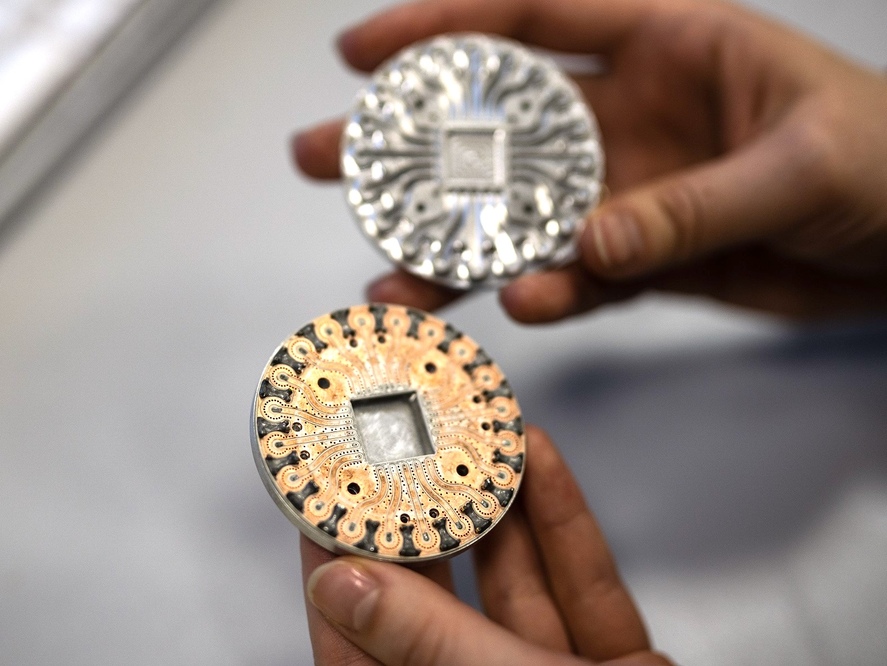

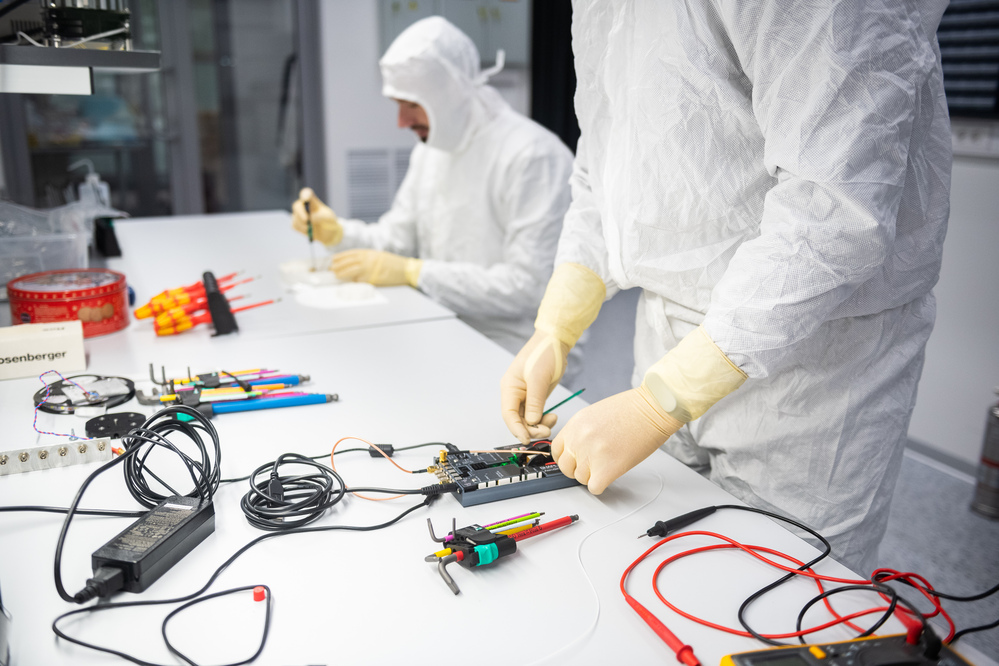
Neutral atoms are among the most promising platforms for implementing qubits, and interest in this technology continues to grow. Recently, Google Quantum AI also launched research in this area. To enable interactions between qubits, atoms are temporarily excited into highly excited Rydberg states, which dramatically enhance the interaction strength. But only over short distances. Two distant qubits cannot interact directly, so operations between them must be performed through a chain of intermediate atoms. Since each additional operation introduces a certain probability of error, and the chain length increases proportionally with processor size, the overall computational accuracy decreases. As a result, the probability of successfully executing a logical operation drops exponentially as the number of qubits grows.
“Existing neutral-atom quantum processors resemble a city where you can only talk to your nearest neighbor. To send a message across town, it has to be passed from person to person, with the meaning becoming slightly distorted each time. We have proposed a scheme in which the number of operations is fixed and does not depend on the size of the system. In other words, the information bypasses unnecessary intermediaries and reaches its destination without degradation,” said Ivan Dudinets, Research Fellow at the Russian Quantum Center.
The researchers divide qubits into two categories. Computational qubits remain fixed in a static array of optical tweezers throughout the computation. Messenger qubits, which are special mobile atoms, transport quantum information between any two computational qubits. A messenger atom approaches the first qubit, acquires its quantum state, moves to the second qubit, and performs the required quantum operation. The messenger can then either be discarded or reused.
The proposed concept includes five different architectures, distinguished by the way messenger atoms are transported. These include conveyor-belt schemes using moving optical traps, a free-flight approach in which atoms travel ballistically before being recaptured, and hybrid architectures combining routing strategies with quantum teleportation. The full results have been published in the leading international journal Physical Review A.
“All five architectures solve the same fundamental problem. The difference lies in how the messenger qubit is transported. In conveyor architectures, the atom travels inside a moving optical trap. In free-flight schemes, it is launched like a projectile and interacts with qubits while in motion. Hybrid architectures employing quantum teleportation reduce the number of operations by measuring the qubit directly during computation. At present, the bidirectional conveyor architecture appears to be the most experimentally feasible, since all of its essential components have already been demonstrated. However, it also requires the largest number of operations and is therefore the most sensitive to the fidelity of physical gates. We see strong potential for its experimental implementation,” said Alexey Fedorov, PhD, Head of the College of Physics and Quantum Engineering at NUST MISIS.
The research was supported by Rosatom State Atomic Energy Corporation under the Quantum Computing Roadmap (Agreement No. 868-1.3-15/15-2021, dated October 5, 2021). The work carried out at NUST MISIS was conducted within the framework of the strategic technological project “Quantum Internet” under the Russian Ministry of Science and Higher Education’s Priority 2030 program.