To improve mine degassing planning and assess methane emission risks, Russian researchers have identified the models that are most effective for estimating coal seam permeability under changing stress conditions.

Permeability indicates how easily gas or liquid can flow through rock. This parameter is particularly important for coal seams, as it determines how effectively methane can be removed before mining begins and during extraction. Inaccurate permeability estimates can reduce degassing efficiency and increase the risk of hazardous gas-dynamic events in mines.
However, a coal seam cannot be treated as a uniform material. It contains pores and a network of natural fractures known as cleats. Gas flows primarily through these fractures. As the stress acting on the coal increases, the fractures may close, reducing permeability. When the load decreases, they may open again. Coal is also affected by its interaction with gas: during gas adsorption, the coal matrix swells, while desorption causes it to shrink.
To determine how these processes should be accounted for in calculations, researchers from NUST MISIS, together with experts from the Geophysical Center of the Russian Academy of Sciences and SUEK-Kuzbass JSC, examined five existing permeability models. Some primarily account for the compression of pore spaces and fractures, while others consider changes in coal properties during gas adsorption and desorption, porosity, or the mechanical characteristics of the rock.
“There is no universal model that is equally suitable for all coal seams. The choice should depend on the depth of the seam, the range of applied loads, the structure of the fracture network, the gas content of the coal, and the nature of its deformation. This approach makes it possible to account for the actual characteristics of a specific rock mass rather than applying the same relationship under different conditions,” said Konstantin Kolikov, Head of the Department of Mining Safety and Environmental Engineering at NUST MISIS.
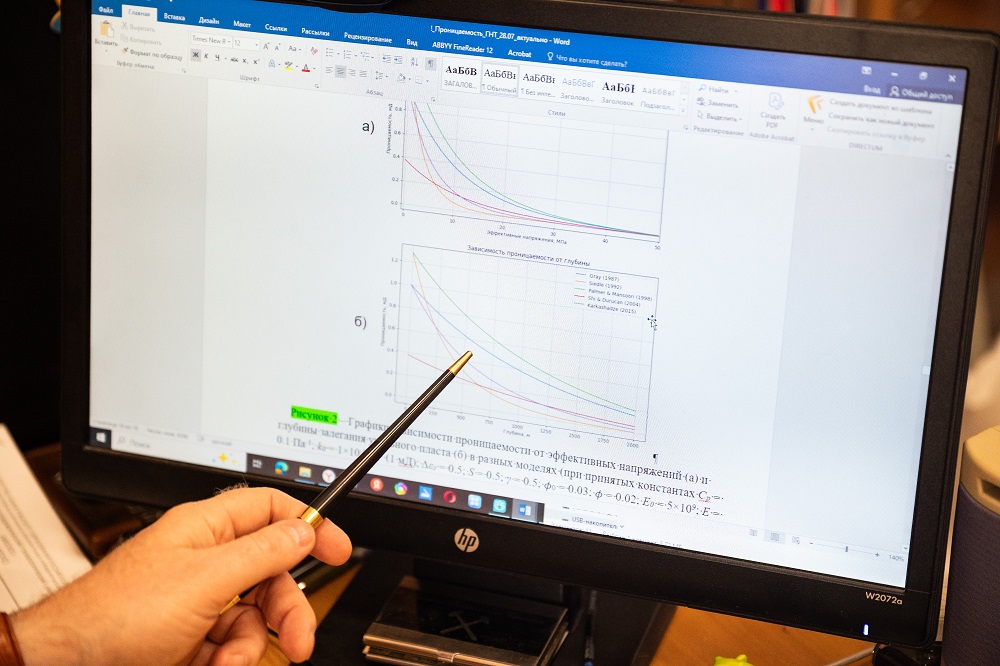
To compare the models, the researchers carried out a series of numerical simulations. They examined effective stresses ranging from 0 to 50 MPa and depths of up to 1,500 metres. They also assessed the sensitivity of the models to changes in key parameters, including porosity and deformation caused by interactions between coal and gas.
The results showed a consistent trend: coal seam permeability decreases nonlinearly as the load increases. In the simulations, the most pronounced decline occurred at effective stresses of approximately
The researchers found that the Seidle model is best suited to situations in which sorption-induced coal deformation needs to be taken into account. The Palmer—Mansoori approach can be applied to deep seams where changes in porosity are significant, while the Karkashadze—Khoutiev model makes it possible to account for the influence of the rock mass’s elastic properties. The findings are described in the journal Mining Science and Technology (Q1).
The results can be used to develop 3D models of coal deposits for assessing degassing efficiency, predicting gas behaviour within coal seams, and selecting drainage well parameters. According to the authors, choosing the appropriate model can reduce uncertainty when designing degassing systems and help engineers make better-informed decisions about the placement and operation of degassing wells.
The study was supported by the Russian Science Foundation (Project No.