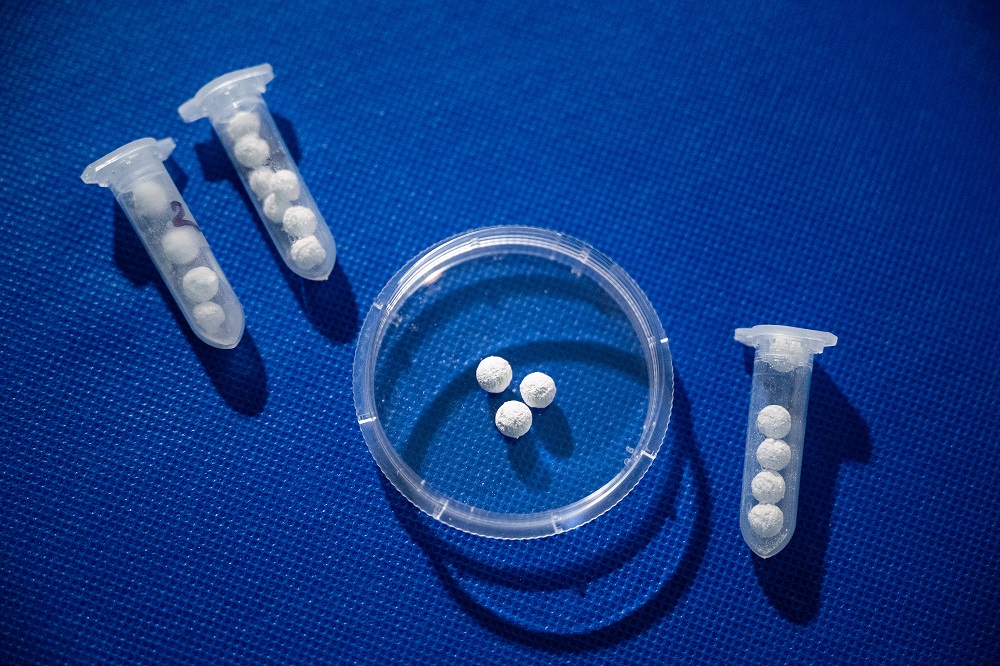
Scientists at NUST MISIS have patented special granules designed to repair damaged bone tissue. The material is based on a compound whose composition is similar to the mineral component of bone. By incorporating strontium and silver ions, the new material promotes integration with surrounding tissues and exhibits antibacterial activity. The granule production technology also makes it possible to control the rate at which the material gradually dissolves in the body.
Bone defects can occur following severe fractures, diseases, or surgical procedures. When the damaged area is extensive, the body’s natural regenerative capacity may not be sufficient to restore it fully. In such cases, doctors use osteoplastic materials — specialized substitutes that fill the defect and create conditions for new bone tissue to form.
One of the most widely used materials in this field is hydroxyapatite. Its composition closely resembles the mineral component of bone, making it a suitable basis for biomaterials. However, existing materials have several limitations, including insufficient mechanical strength, low porosity, and slow dissolution rates. Another challenge is the lack of antibacterial activity, which is particularly important when treating areas at risk of infection. In addition, manufacturing some materials requires considerable time and energy.
Scientists at NUST MISIS have proposed addressing these challenges with granules in which some of the ions that form the crystal structure of hydroxyapatite are replaced with strontium and silver ions. This modification makes it possible to influence several material properties simultaneously.
“Silver is known for its antibacterial properties, but excessive amounts can harm not only bacteria but also the body’s own cells. It is therefore essential to determine the right concentration of silver to achieve the desired antibacterial effect without damaging healthy tissue. Strontium, in turn, is a trace element found in bone tissue and plays an important role in osteogenesis. By combining these two elements in the new material, we aim to achieve antibacterial activity while improving osseointegration — the ability of a material to interact with bone tissue and become integrated into it,” said Ekaterina Chikanova, PhD in Chemistry and Associate Professor at the Department of General and Inorganic Chemistry at NUST MISIS.
The granules are more than just hydroxyapatite powder: they are a material with a defined structure that allows its properties to be controlled. By adjusting the composition and production conditions, researchers can regulate porosity, mechanical strength, and the rate of dissolution in the body. Laboratory tests have shown that the material dissolves over a period of at least three weeks.
The porous structure allows fluids to penetrate the material and interact with cells, while the granules retain sufficient strength and effectively fill bone defects. This makes it possible to combine several essential characteristics in a single material: strength, porosity, and controlled resorption. The production process is also relatively simple. The researchers are optimizing the composition and drying conditions to ensure consistent material properties and enable production to be scaled up. The research findings have been published in the scientific journal Inorganic Materials.
“The development is intended for use in traumatology, orthopedics, maxillofacial surgery, and dentistry. The next stage of the project involves producing a prototype of the granular material and further evaluating its properties,” said Kirill Kucheryaev, co-author of the development and a postgraduate student at the Department of Functional Nanosystems and High-Temperature Materials at the NUST MISIS College of New Materials.
According to Alevtina Chernikova, Rector of NUST MISIS, the university’s researchers are shaping a relevant scientific and educational agenda in biomedicine under the national Priority 2030 program. They are developing materials and technologies designed to improve the quality of life for millions of people and accelerate treatment in complex medical cases.
In the future, the technology could provide a basis for domestic production of osteoplastic materials with controlled properties. The researchers highlight several key advantages of the development, including low production costs, scalability, a controlled resorption rate, antibacterial properties, and the potential to accelerate osseointegration.